What are TargetBoard Agents
Overview. TargetBoard Agents are AI-powered operational analysts that monitor your company’s data, detect meaningful changes, and surface actionable insights before they become surprises. Instead of…
Overview
TargetBoard Agents are AI-powered operational analysts that monitor your company’s data, detect meaningful changes, and surface actionable insights before they become surprises.
Instead of expecting leaders to constantly review dashboards, Agents proactively look for risks, bottlenecks, trends, and opportunities across your engineering and operational data.
Use Agents to answer questions like:
- Are we on track?
- Where are we slowing down?
- Is quality improving, stable or decreasing?
- Are teams blocked?
- Is AI improving real productivity?
These insights are then delivered directly to you so that they can be reviewed and any appropriate actions can be taken.
Agents and Signals
Agents | Signals |
Agents are AI analysts, each focused on specific operational domains, including:
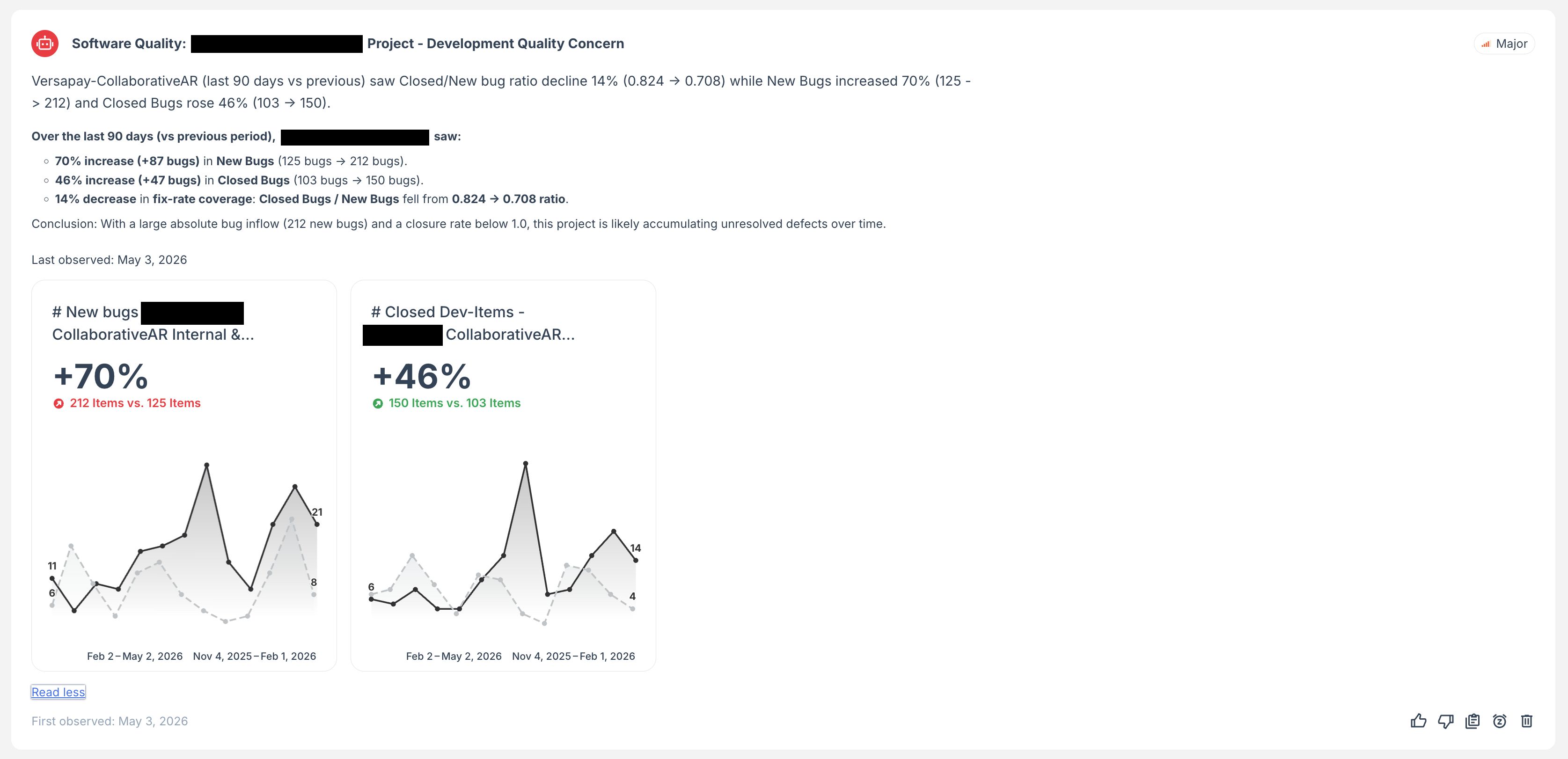
Agents continuously monitor relevant metrics, trends and operational patterns over time, then create Signals for your review based on their findings. You can define the scope of the data considered by the agent (for example to a particular team or project), and give it feedback to teach it what is most important to you over time. For example, a Velocity Agent can monitor cycle time, throughput, blocked work, pull request review time and delivery trends. | Signals are insights generated by Agents. A signal is created when an Agent detects a meaningful change, risk, anomaly or opportunity in the data. Each Signal explains:
For example, cycle time for Squad 20 increased by 47% during the report period, while completed work decreased by 22%. The increase appears to be driven by longer PR review times and more items spending time in blocked status. Signals are designed to be actionable. They are meant to help you quickly understand where attention is needed. |
Why use Agents?
Agents let the system tell you when something is happening that deserves your attention, even if it isn't explicitly displayed on a board or, more frequently, requires detailed analysis of several metrics in parallel to see what is happening.
This helps reduce:
- Manual reporting and analysis
- Missed risks
- Late discovery of bottlenecks
- Repetitive metric reviews
- Dependency on human analysts for operational questions
- Surprises in planning meetings and executive reviews.
How did we do?
Get Started with Your First Agent
